What the Order of a Cosmetic Ingredient List Tells You
Cosmetic ingredient list order can hint at a formula’s composition, but it cannot predict how a product will feel, perform or suit your skin.
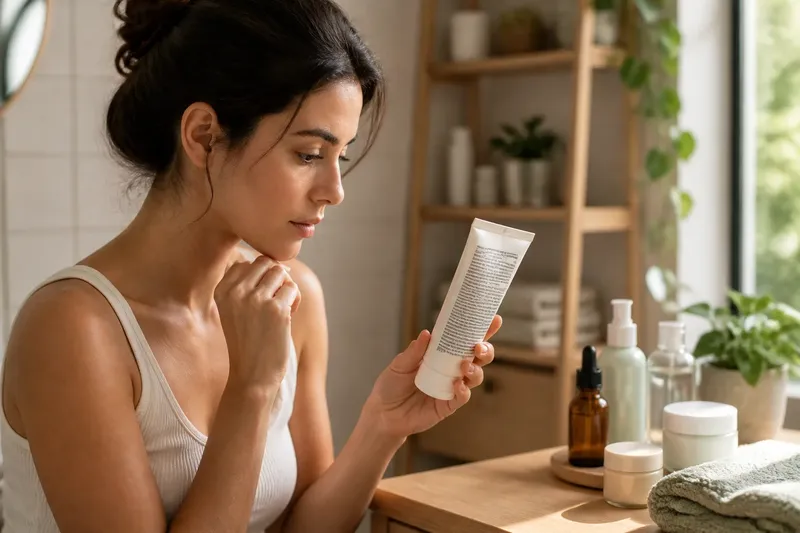
The most common mistake with cosmetic ingredient list order is treating the first few names as a ranking of results. That can make a perfectly useful label look like a promise—or a warning—when it is only a partial account of a formula. Read the list as a clue to composition, not a forecast of what your skin will do.
What does cosmetic ingredient list order show?
For many cosmetics, ingredients are listed in descending order by weight as they are added to the product. The first names therefore generally account for more of the formula than names further down. If water appears first on a moisturiser, water is likely a substantial part of its composition; a later plant extract is likely present in a smaller amount.
That is useful, but it answers a narrow question: broadly, what is present in greater or lesser quantity? It does not tell you how strongly an ingredient acts, how well it is delivered, or how the finished product behaves. A small amount of a potent colourant can make a visible difference, while a large amount of water may mainly provide the product’s base.
Think of the list as a map of relative presence, not a league table of importance. Ingredients with different jobs cannot be compared simply by counting how high they appear.
Why do the first ingredients often look familiar?
Many formulas begin with a base that gives the product its texture and helps carry other ingredients. Water is common in lotions and gels. Oils, silicones, fatty alcohols or waxes may help give creams, primers and balms their slip, structure or lasting feel. Cleansers may begin with water and surfactants, the ingredients that help lift oil and soil from the skin.
These early entries are not filler merely because they sound ordinary. The base shapes how a formula spreads, dries, rinses or sits on the skin. It can also affect how other components are dispersed. Two products with a similar headline ingredient may feel quite different because their supporting ingredients and overall structure differ.
Say you are comparing two face creams and both list glycerin near the top. One also includes a richer mix of emollients, while the other has a lighter gel-like base. You might expect different textures, but the lists alone cannot settle which will feel better on your skin; trying a sample, where available, is more informative than treating glycerin’s position as a verdict.
What can you infer from an ingredient’s position?
Position can help you make cautious comparisons within the same kind of product. If a familiar moisturising ingredient appears near the top of one lotion and much lower in another, that may suggest it makes up a larger share of the first formula. It does not establish that the first lotion moisturises more effectively. The rest of the formula, the ingredient’s form and the way the product is used all matter.
Look for clusters as well as individual names. A formula may contain several humectants, which attract water, alongside emollients that soften and smooth, and occlusive ingredients that help reduce water loss. Their combined arrangement can tell you more about the formula’s intended character than the position of one celebrated ingredient.
Ingredient names also have different levels of specificity. Some are familiar everyday terms; others are standard names for compounds or botanical materials. If a name is unfamiliar, a reliable ingredient glossary can help identify its general function, but do not assume that a broad function explains its role in this particular product.
Where does the label stop answering questions?
Ingredient order is not a complete recipe. It does not usually reveal exact concentrations, the manufacturing process, the quality or source of a raw material, or how ingredients interact after formulation. Nor does it tell you whether a product has been stored well or is still within its usable period.
In some labelling systems, ingredients present below a particular threshold may be listed in flexible order after the ingredients above that threshold. Colour additives can also follow special ordering conventions. So, once you reach the lower part of a list, adjacent positions may not support the close comparison a reader might hope to make. Requirements vary by market and product type; follow the label, manufacturer’s information and local rules where a detail matters.
A label may also use a collective term or give limited detail where regulations allow it. If a name matters to you because of an allergy, sensitivity or personal preference, do not guess from a marketing description. Check the full ingredient declaration and contact the manufacturer if it remains unclear.
Why isn’t order a forecast of results?
A product’s outcome depends on more than how much of an ingredient it contains. The ingredient’s form, concentration, stability, surrounding formula and contact with the skin can all shape its effect. A list cannot tell you whether an active ingredient remains stable in the package, or how the finished product was designed to work.
Skin is not a uniform surface, either. A formula can feel comfortable for one person and irritating or greasy for another. Application amount, frequency, other products in the routine and individual sensitivities also change the experience. A high-ranking ingredient is not automatically a match, and a low-ranking one is not automatically irrelevant.
This is why ingredient order is better for asking informed questions than predicting a result. If you are considering a product for a specific concern, look for clear use directions and product information, then introduce it cautiously in a way that suits your skin. For persistent irritation or a medical skin condition, seek advice from a qualified health professional.
What do readers often ask about ingredient order?
Does the first ingredient make up most of the product?
It is generally the ingredient present in the greatest amount by weight, but that does not necessarily mean it makes up more than half of the formula. The list gives relative order, not a full percentage breakdown.
Can I compare ingredient positions across two products?
You can make a cautious comparison when the products have similar purposes and the lists use comparable labelling conventions. Position alone cannot tell you which product will perform better or suit you more.
Does a low-listed active ingredient do nothing?
No. Some ingredients can have a role at relatively low levels, and the label does not disclose the full formulation context. A lower position is not proof of ineffectiveness.
Can the ingredient list tell me whether a product will irritate me?
It may help you spot an ingredient you already know you avoid, but it cannot predict everyone’s response. Sensitivity varies, and a list cannot account for how your skin responds to the complete formula.
How can you read a list without overreading it?
- Start with the product type. A cleanser, cream and tinted balm need different kinds of ingredients, so compare like with like.
- Read the early entries for the base. Notice whether water, oils, waxes or other materials appear to shape the product’s texture.
- Identify ingredients relevant to your own needs. A familiar ingredient may help you decide what to ask next, but its position is not a performance score.
- Check the whole list for known avoidances. Do not stop after the first handful of names if an ingredient matters to you.
- Use manufacturer information for missing detail. Ask about a specific uncertainty rather than inferring a concentration or result from order.
Cosmetic ingredient list order is most helpful when it narrows your questions: what seems to form the base, which ingredients are present, and what would you like clarified? It cannot predict the feel or effect of a finished product. Keep that distinction in view, and the label becomes a useful reading tool rather than a promise.
One practical habit makes the distinction easier to remember: note what the list suggests, then keep that separate from what you actually notice when using a product. That leaves room for evidence from your own experience without asking the label to say more than it can.