Packing a Personal-Care Bag for One Overnight Stay
Packing a personal-care bag for one overnight stay is easier when you follow your usual routine, choose suitable containers and pack in use order.
The common mistake when packing a personal-care bag for one overnight stay is to start with a miniature shopping spree. That can leave you with unfamiliar products, awkward containers and a bag full of things you never use. Packing a personal-care bag for one overnight stay works better when you begin with the routine already waiting in your bathroom.
Consider an invented situation: Maya is staying one night at a friend’s flat after an evening event. She wants her usual face wash, moisturiser, toothbrush and hairbrush, but does not want to carry full-size bottles or unpack half her bathroom. Her solution is not a new routine. It is a small edit: identify what she will actually use, choose a container for each item and pack them in the order they will come out.
What will Maya actually use?
Maya writes down the moments in which she will get ready: before bed, then in the morning. She does not list every product she owns. She asks what she normally reaches for at those times, and whether the item is relevant to this particular night.
Her evening routine includes removing make-up, cleansing and moisturising. In the morning, she brushes her teeth, rinses her face, applies moisturiser and combs her hair. She usually uses a styling product, but expects to leave with her hair simply brushed. That choice removes a bottle without changing the routine she values.
This distinction matters. A one-night bag is not a miniature version of the whole bathroom; it is a record of the useful parts of the next day. Maya leaves out her occasional exfoliant and a spare face mask. Neither belongs to her ordinary evening-and-morning sequence, so neither earns a place simply because there is room.
Write the routine as moments, not as a catalogue of products.
Which containers suit the products?
Now Maya matches each product to a container. Her cleanser is a liquid, her moisturiser is a cream, and her make-up remover comes in a small, closed bottle. She uses clean, well-sealed travel containers that are suitable for their contents, rather than transferring everything into whichever jars are empty.
A container should be easy to identify and open, and its closure should stay secure in a bag. A small screw-top pot may suit a thicker cream if the packaging is intended for that product; a flip-top bottle may be more convenient for a runnier wash. If Maya cannot tell what is inside, she adds a clear label. That is especially useful when similar-looking products sit side by side.
She keeps products in their original packaging when a small size is already available. That avoids unnecessary decanting and preserves the product’s own label. For anything she does transfer, she checks that the container is clean and dry, closes it firmly and keeps it upright where possible. Product labels and manufacturer directions take precedence if they specify storage or packaging conditions.
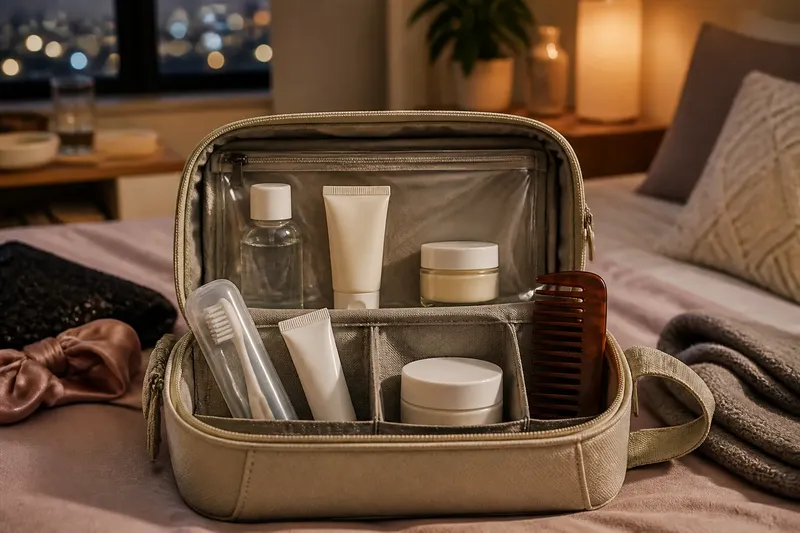
Toothpaste is different from a liquid face product: Maya takes a small tube rather than trying to squeeze it into a cosmetic pot. Her toothbrush goes in a ventilated cover after it is dry. A comb needs no container at all, so it goes in a separate pocket where its teeth will not catch on a soft cloth or hair tie.
How should the bag follow the routine?
Maya packs for the order of use, not by grouping every bottle together. In the evening section, the make-up remover comes first, followed by cleanser and moisturiser. In the morning section, the toothbrush and toothpaste sit together, with face moisturiser nearby and the comb in its own pocket.
A small wash bag with separate compartments makes this simple, but a zip pouch and a clean, reusable bag can do the same job. The point is to keep leak-prone liquids away from items that should stay dry, and to make the first thing needed easy to reach. Maya places the remover and cleanser in a sealed pouch within the bag; the toothbrush cover and comb stay outside that pouch.
She also considers what happens at the destination. If she expects to use a shared bathroom, she wants to carry the pouch in one trip and keep her belongings together. If she will be changing in a bedroom, the same arrangement still helps: the morning items can be lifted out without rummaging through the evening products.
Put the first-use item where your hand will find it without searching.
What if a product will not fit neatly?
Maya finds that her usual cleanser bottle is too bulky for the pouch. Rather than decanting in a hurry, she checks whether she has a suitable travel-size version or an appropriate, clean travel bottle. If neither is available, she considers whether a small amount of the original product can be carried securely in its packaging. She does not substitute an unfamiliar cleanser just to make the bag look compact.
Imagine a different constraint: the only available pot has previously held a scented balm. Even after washing, a lingering fragrance could be unwelcome in a face product. In that invented situation, the sensible observable result is to leave the pot aside and use clean packaging made for the product, or take the original container. A container is not useful if it changes the product or makes it hard to use.
For a product Maya uses only occasionally, she makes a clear choice: include it because she expects to need it, or leave it at home. “Perhaps” is not a packing category. If she has a genuine concern about missing a product, she can choose a familiar substitute she already tolerates rather than adding several speculative extras.
What do people ask about an overnight bag?
What personal-care items should go in an overnight bag?
Start with the products and tools used in your normal evening and morning routines: for example, cleanser, moisturiser, toothbrush, toothpaste and a comb. Add make-up remover, hair products or other personal items only if you expect to use them during the stay.
Can I use travel containers for skincare?
Travel containers can be convenient when they are clean, close securely and suit the product’s texture and storage needs. Keep a product in its original packaging if its directions call for that, and label any transferred contents so they are easy to recognise.
How do I stop toiletries leaking in a bag?
Check that closures are firmly shut, keep liquid products upright where practical and place them in a separate sealed pouch. Keep that pouch apart from dry items such as a toothbrush cover, comb or clean cloth.
Should I pack products I do not use every day?
Pack an occasional product only when you have a specific reason to expect you will use it. For a single night, leaving speculative extras at home usually makes the bag easier to find your way around.
What does Maya check before leaving?
Maya puts the bag beside her overnight clothes and runs through the two moments she planned for. At bedtime, she can reach the remover, cleanser and moisturiser. In the morning, she can find her dental items, face moisturiser and comb. She has not packed a new step, and she has not forgotten the products that make her familiar routine feel complete.
- Routine: Does every item belong to an evening or morning use she expects?
- Container: Is it suitable for the product, clean, closed and easy to recognise?
- Order: Can she reach items in the sequence she will use them?
- Separation: Are leak-prone products kept away from dry belongings?
- Extras: Is each occasional item there for a clear reason?
That is the useful result of Maya’s invented packing method: a bag shaped around her existing habits, not around a fantasy of becoming a different sort of traveller. For your own personal-care bag for one overnight stay, make the final check against the next evening and morning, then close the zip and leave the rest on the shelf.