From Kohl to Compact: A Short History of Portable Beauty
The history of portable beauty traces how kohl containers and powder compacts made cosmetics easier to carry, apply and refresh away from home.
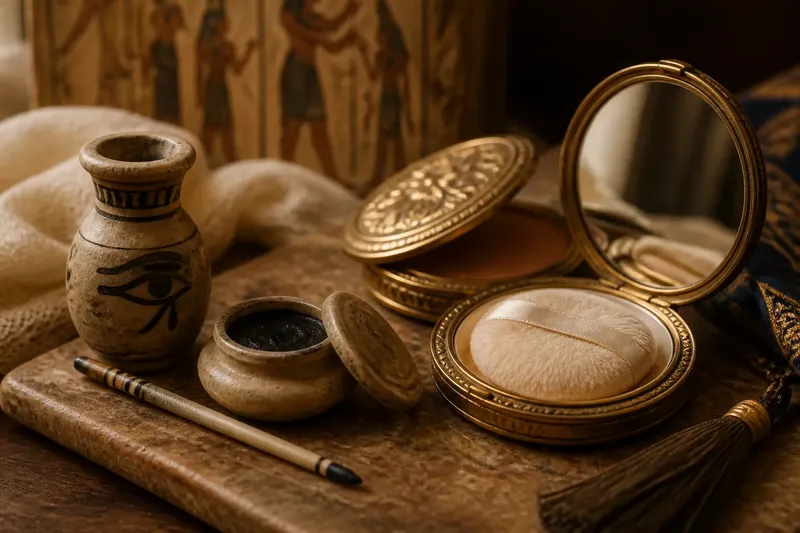
The most common mistake in telling the history of portable beauty is to treat the compact as its beginning. That overlooks earlier, region-specific objects such as kohl containers from ancient Egypt—and misses how the wish to carry cosmetics shaped their design.
What counts as portable beauty?
Portable beauty means cosmetics and the objects used to apply or refresh them beyond a fixed dressing table. The idea includes pigment kept in a vessel, a stick of colour wrapped for travel, or a mirror paired with a powder puff. Portability is not simply a matter of size: a container must protect its contents, open conveniently and suit the way a product is applied.
Different products demanded different solutions. Loose powder could spill; a moist preparation needed to stay contained; pigment intended for the eyes called for a precise applicator. The form of each object reflected the material it held and the habits of the person carrying it.
Think of portable beauty as a small system: product, container, applicator and mirror, sometimes gathered in one object and sometimes kept apart.
How were kohl and eye paint carried in ancient Egypt?
In ancient Egypt, eye cosmetics included dark pigments commonly called kohl, though ingredients and preparations varied. Archaeological finds include small cosmetic vessels and applicators associated with eye paint. Such objects offer specific evidence for ways cosmetics could be stored and applied; they do not establish a single routine shared by every person or period.
A small vessel kept pigment together, while a slender applicator allowed it to be placed around the eye. The container and stick did not need to form a modern-style touch-up kit: a mirror might be separate, or the user might apply the cosmetic without one. This is a more precise claim than saying that people everywhere carried kohl in the same way.
The distinction matters. A vessel can make a cosmetic portable without including a mirror, puff or hinged lid. Later compacts bundled more functions together, but they did not invent the idea of keeping beauty materials ready for use away from a fixed dressing place.
Why did the compact become so recognisable?
The compact joined several tasks in a neat case. Powder could be held inside, a puff stored with it, and a mirror used without a separate looking glass. A hinged lid turned the act of opening the case into access to a small personal work surface.
Its appeal came from this combination as much as from its appearance. A mirror answers, “Where can I apply this?” The powder and puff answer, “What can I use?” A secure case answers, “How do I carry it?” When those needs meet, a compact becomes more than a container: it becomes a portable arrangement for a particular kind of touch-up.
Compact designs also made the object visible as an accessory. Surfaces could be decorated, shaped or finished to suit their owners’ tastes. Ornament and utility were not opposites: a case could be attractive and still keep powder and applicator together.
What changed when cosmetics became easier to carry?
Carrying cosmetics made it easier to refresh one’s appearance away from the place where one first got ready. A private room, a social visit or a pause during an outing could become a moment for checking or adjusting the face. The tool made the action more convenient, but it also helped define where that action could happen.
The compact’s mirror is especially revealing. It turns attention back towards the user, briefly and within the small frame of the case. A mirror attached to a powder container makes inspection part of application: open the case, look, adjust, close it. The object choreographs a brief routine without requiring a full dressing table.
Say you are leaving home with a loose powder jar that is awkward to open and easy to spill. You switch to a compact holding powder and a puff, with a mirror inside the lid. The expected result is a more contained touch-up with fewer separate items to handle. This invented situation shows the practical change: portability reorganises the task, not merely the packaging.
How did applicators shape the experience?
An applicator is not an afterthought. It determines how a product reaches the face and how much handling the user needs to do. A narrow stick suits a targeted line of pigment; a puff spreads powder across a broader area; a small brush can place colour more precisely than fingers. Each design supports a different cosmetic and gesture.
Keeping an applicator inside a container can make a set feel complete, but it brings trade-offs. A puff takes up space. A stick needs somewhere to rest. A brush may need protection from residue. Designers balance convenience with cleanliness and with the physical limits of a case that must be carried.
These choices affect the pace of use. A tool ready beside its product invites a quick, direct action. A separate tool adds another object to find and manage. That is why the history of portable beauty belongs as much to small implements as to powders, pigments and creams.
What do readers ask about the history of portable beauty?
Did people use portable cosmetics before compacts?
Yes. Finds from ancient Egypt include small cosmetic vessels and applicators, showing that cosmetics could be stored and applied without a mirror or puff joined into the same case. The compact later brought several useful parts together in one object.
Was a compact always used for powder?
Powder is strongly associated with the compact because a case can hold the product and an applicator together. The broader idea of a portable beauty container also applies to other preparations and their tools.
Why did compacts include mirrors?
A mirror allowed someone to apply or adjust cosmetics where no dressing-table mirror was available. Its presence also made the case a more self-contained tool rather than a container alone.
Were portable beauty objects purely practical?
No. Their usefulness mattered, but cases could also be decorative personal possessions. A compact might express taste while still protecting its contents and making a touch-up easier.
Why do these old objects still matter?
Portable beauty objects show that routines are shaped by more than formulas. A container can make a cosmetic easy or awkward to carry; an applicator can turn it into a quick gesture or a careful one; a mirror can make an adjustment possible in a new setting. The object quietly sets the terms of use.
They also make beauty history less abstract. An ancient Egyptian vessel for eye pigment and a powder compact solve related but distinct problems. One stores a preparation and may be paired with an applicator; the other can gather product, puff and mirror into a single case. Their differences reveal how tools answered different practical needs.
The history of portable beauty is not just a sequence of smaller containers. It is a history of moving the dressing-table task into the hand, the bag and the pause between one place and another. When looking at an old case, ask what it held, how it was applied and what its owner needed to do away from home.